Solar Still
|
|
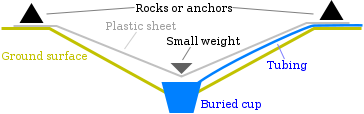
Solar still built into a pit in the ground
|
A solar still distills water, using the heat of the Sun to evaporate, cool then collect the water. There are many types of solar still, including large scale concentrated solar stills, box and pit stills, and stills made from water bottles or plastic bags. In a solar still, impure water is contained outside the collector, where it is evaporated by sunlight shining through clear plastic or glass. The pure water vapor condenses on the cool inside surface and drips down, where it is collected and removed.
Distillation replicates the way nature makes rain. The sun's energy heats water to the point of evaporation. As the water evaporates, water vapor rises, condensing into water again as it cools and can then be collected. This process leaves behind impurities, such as salts and heavy metals, and eliminates microbiological organisms. The end result is pure distilled water.
Solar stills are used in cases where rain, piped, or well water is impractical, such as in remote homes or during power outages. In subtropical hurricane target areas that can lose power for days, solar distillation can provide an alternative source of clean water.
A simple basin-type solar still can be constructed with 2-4 stones, plastic film or transparent glass, a central weight to make a point and a container for the condensate. A cubic hole in moist ground is created of about 30 cm (12 inches) on each side. Into the centre of this hole, a collection container is placed. Then a sheet of plastic film is stretched over the hole.
A concentrated solar still is a system that uses the same quantity of solar heat input (same solar collection area) as a simple solar still but can produce a volume of freshwater that is many times greater. While a simple solar still is a way of distilling water by using the heat of the sun to drive evaporation from a water source and ambient air to cool a condenser film, a concentrated solar still uses a concentrated solar thermal collector to concentrate solar heat and deliver it to a multi-effect evaporation process for distillation, thus increasing the natural rate of evaporation. The concentrated solar still is capable of large-scale water production in areas with plentiful solar energy.
See also:
https://en.wikipedia.org/wiki/Solar_still
https://en.wikipedia.org/wiki/Concentrated_solar_still
Source: Wikipedia (All text is available under the terms of the GNU Free Documentation License and Creative Commons Attribution-ShareAlike License.)
|