Definition
The Dirichlet problem is the problem of finding a function which solves a specified partial differential equation (PDE) in the interior of a given region that takes prescribed values on the boundary of the region.
General solution
For a domain D having a sufficiently smooth boundary  , the general solution to the Dirichlet problem is given by , the general solution to the Dirichlet problem is given by

where G(x,y) is the Green's function (used to solve inhomogeneous differential equations subject to specific initial conditions or boundary conditions) for the partial differential equation, and

is the derivative of the Green's function along the inward-pointing unit normal vector  . The integration is performed on the boundary, with measure ds. The function ν(s) is given by the unique solution to the Fredholm integral equation of the second kind, . The integration is performed on the boundary, with measure ds. The function ν(s) is given by the unique solution to the Fredholm integral equation of the second kind,
 . .
The Green's function to be used in the above integral is one which vanishes on the boundary:
G(x,s) = 0
for  and and  . .
Such a Green's function is usually a sum of the free-field Green's
function and a harmonic solution to the differential equation.
Existence
The Dirichlet problem for harmonic functions always has a solution,
and that solution is unique, when the boundary is sufficiently smooth
and f(s) is continuous. More precisely, it has a solution when
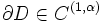
for 0 < α, where C(1,α) denotes the Hölder condition (a real or complex-valued function ƒ on d-dimensional Euclidean space satisfies a Hölder condition when there are nonnegative real constants).
Source: Wikipedia (All text is available under the terms of the GNU Free Documentation License and Creative Commons Attribution-ShareAlike License.)
|